Building and working with CPG brands over the years, I've noticed something unsettling: profitable brands working harder every quarter (hiring more people, running more promotions, launching new SKUs) yet their margins keep shrinking.
It's hard not to pause and ask: why?
The answer isn't what most people think. It's not market saturation. It's not competition. It's not even the product.
It's structural revenue losses compounding faster than growth can replace it.
Across food, beverage, and consumer goods, nearly 85% of brands fail within two years of launch (Nielsen).
While product–market fit and easy substitution are often blamed, the reality is more uncomfortable. Even brands that do achieve product-market fit still fail because structural profit leaks silently drain cash faster than growth can replace it.
After working inside CPG organizations and studying hundreds of brands, the pattern is painfully consistent. The same issues appear again and again, regardless of category or channel.
Below are the four silent killers that drain CPG profitability, and why most of these losses are entirely preventable.
Reason #1: Revenue Leaks Through Deductions
Deductions are one of the most painful losses because they feel unavoidable.
In reality, they are not.
In the Order-to-Cash workflow, AR teams regularly see $100K-$150K per month in short-pays across retailers, channels, and formats. Some deductions are valid. Many are not.
Why don't teams fight back? Fear.
Fear of retaliation. Fear of losing the account. Fear that disputing simply isn't worth the effort.
But here's the truth: retailers respect suppliers who establish boundaries. The real problem is that teams lack the time, data, patience, and systems required to identify and dispute invalid claims.
For a $50M brand, deductions average roughly 3.75% of revenue, or $1.875M per year. Most brands recover only 5-10% of invalid deductions, which means $900K-$1M annually is quietly written off as "the cost of doing business."
Reason #2: Critical Insights Trapped in Data Silos
CPG data lives everywhere: ERP systems, retailer portals, POS feeds, SPINS or Nielsen reports, email threads, and PDFs.
Stitching this together into insight is not the job of your sales manager. It's the job of a data scientist.
But here's the catch: most mid-market brands can't hire or retain one. I've yet to meet many data scientists excited to work for a sauce company in Texas.
So what happens instead is predictable.
Overburdened analysts become bottlenecks. Pseudo-analysis leads to wrong conclusions. Decisions get delayed.
And delays are expensive.
Imagine a retailer asking your sales team, "What's your velocity in comparable stores?"
Your team responds, "Let me get back to you in three days."
Your competitor answers instantly and wins the deal.
For a $50M brand, roughly 15% of key account pitches are delayed due to data bottlenecks. About 35% of those result in lost deals. Lose just one $3M account, and you've lost approximately $900K in gross profit.
Reason #3: Inventory Forecasting Kills Quietly
"All forecasts are wrong. Some forecasts are useful."
As an industry, we've taken this quote too far.
Today, most inventory forecasts are little more than historical averages living in spreadsheets. They don't incorporate real demand signals. They don't explain uncertainty. And they don't improve with time.
As a result, teams spend enormous energy reacting to the market instead of predicting it.
I've been in countless leadership meetings where inventory gets written off silently and someone says, "That was the right decision with the information we had at the time." It's a polished sentence that often hides a harder truth: we didn't have the full information, and we didn't try to get it.
An extreme but very real example came from True Classic's founder, who shared how overestimating demand led to $40M in excess inventory, nearly bankrupting the company.
While that's an extreme case, the pattern is universal.
Excess inventory is dangerous because it traps cash, increases handling and storage costs, gets moved around warehouses, and ultimately ends up marked down or written off. It also creates operational drag across the entire business.
For a $50M brand, just 5% excess inventory means roughly $1M tied up in cash and $800K-$1M lost once storage, markdowns, and write-offs are included.
Under-stocking is often even worse. It leads to lost sales, SLA penalties, retailer fines, and damaged relationships.
Inventory mistakes are frequently the first silent killer on a brand's P&L.
Reason #4: Promotions Without True ROI Understanding
Trade spend is the second-largest P&L line item for most CPG brands, often accounting for roughly 20% of revenue. Yet it is still managed in spreadsheets with little to no visibility into what actually works.
This isn't a new problem.
In the early 1990s, the infamous cereal wars between General Mills, Kellogg's, and Kraft (Post) led to constant price increases followed by aggressive promotions. The result was a vicious cycle that destroyed margins, enriched retailers, and left consumers frustrated. Eventually, consumers voted cereal the worst value product.
Fast forward to today, and brands are still repeating the same mistake.
Promotions look good on revenue reports but quietly cannibalize margin. Without understanding incremental lift, brands end up funding retailer profits instead of their own growth.
For a $50M brand spending $10M annually on trade, only about 40-50% of promotions are truly profitable. The rest is pure waste: roughly $1.5M-$2M per year burned on promotions that don't work.
The Real Issue: Why This Keeps Happening
When you add it all up, the numbers are staggering.
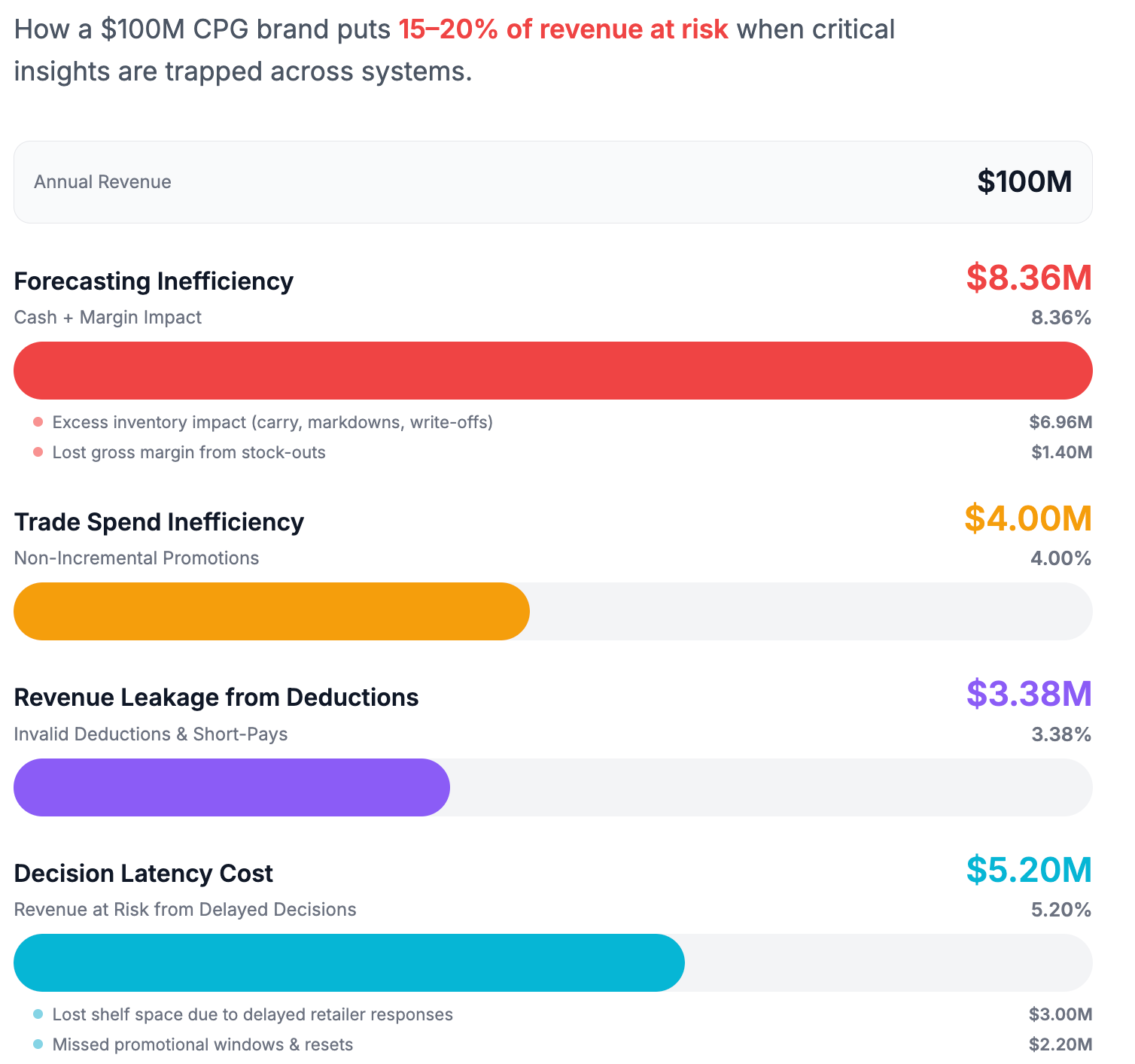
How structural inefficiencies put 15-20% of revenue at risk for a $100M CPG brand
Modern CPG decisions require unified data, continuous forecasting, explainable insights, and embedded workflows.
But most brands can't afford dedicated data scientists, don't have infrastructure built for this reality, and rely on tools that produce dashboards, not decisions.
That gap is where profit leaks live.
The Bottom Line
For a $50M brand, these structural leaks quietly drain $4.4M-$5.3M per year.
Fix just half of that, and you add $2.2M-$2.6M straight to EBITDA.
At an 8-10X EBITDA multiple, that's $17M-$26M in enterprise value without launching a single new SKU.
The irony is that most of these losses are entirely preventable.
The difference between thriving and dying isn't effort. It's execution, powered by the right insights, at the right time.
Continue Reading
Now that you understand the problems CPG teams face, discover how to think strategically about AI solutions:
You Don't Get to Be Neutral About AI AnymoreWhy CPG leaders must decide where AI belongs and where it doesn't
Ready to stop the profit leaks?
See how FeatureBox AI helps CPG brands plug revenue leaks and optimize profitability across their entire P&L.